




|
Expert Insight: Unlocking New Potential through Evolutionary Divergence |
|
Explore our catalog, choose your target, and let us craft a VHH precisely tailored to your specifications! |
|
Why We Choose the "Old World Camel" as Our VHH Discovery Platform |
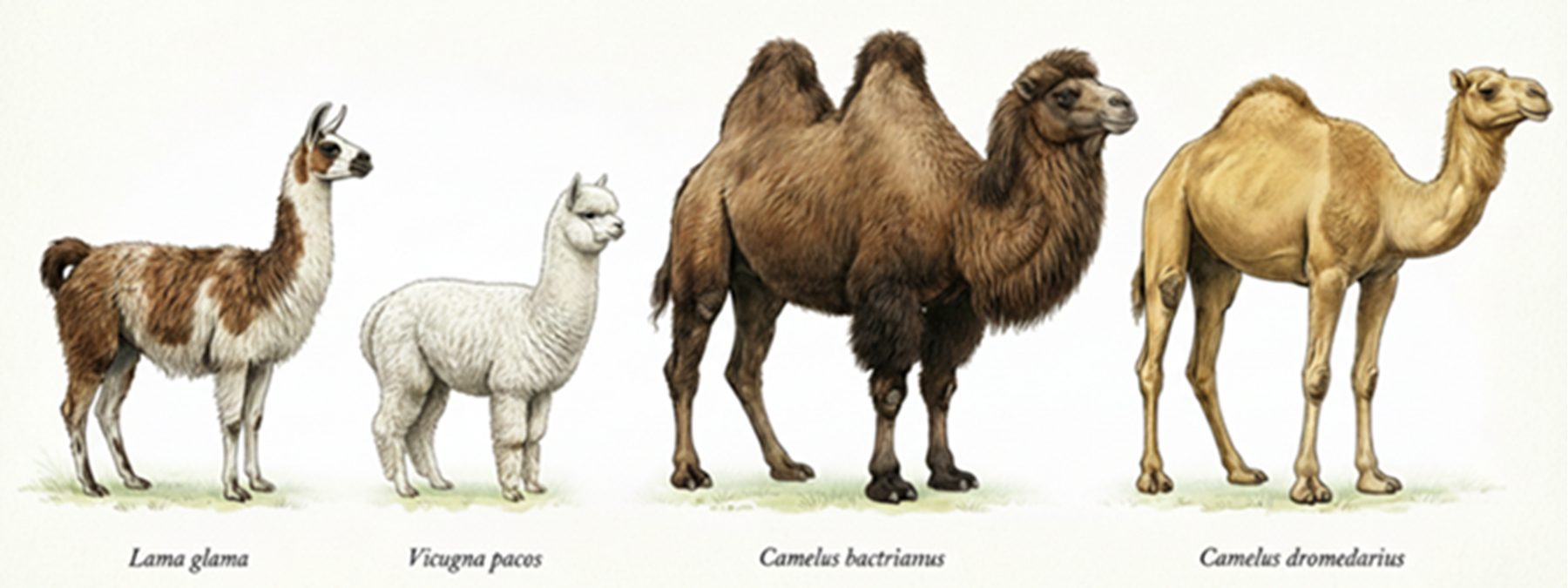
In the landscape of single-domain antibody (VHH/Nanobody) development, the choice of host species is a strategic decision that dictates the therapeutic ceiling of your drug candidates. While the market often groups "New World Camelids" (Alpacas/Llamas) and "Old World Camelids" (Bactrian Camels and Dromedary Camels) together, we aim to dissect the critical value of the Camelus lineage through the lens of scientific evidence and advanced process engineering.
|
Q1: With diverse camelid species available, is there a fundamental difference in the VHHs they produce? |
While they share a family tree, Old World Camels (Tribe Camelini: Dromedary/Bactrian) and New World Camelids (Tribe Lamini: Alpaca/Llama) have followed distinct evolutionary trajectories over millions of years.
Defining the Structure: In structural biology, a "Canonical" disulfide bond refers to the highly conserved Cys22-Cys92 (Kabat numbering) bond found in nearly all Ig variable domains, which is essential for basic folding. The unique, additional disulfide bond evolved in Camelid VHHs is termed "Non-canonical," indicating a specialized evolutionary trait that defies traditional antibody architectural rules.
A significant divergence lies in their reliance on Heavy-Chain-only Antibodies (HCAbs). In Old World Camels, HCAbs constitute up to 75% of circulating IgGs, compared to approximately 45% in the Llama/Alpaca lineage. This suggests that Camels rely more heavily on these miniature antibodies for pathogen defense, implying a germline repertoire honed by more rigorous natural selection.
|
We present the Four-Species Comparative Profile to visualize these distinctions |
Table 1: Structural & Genomic Specifications by Species
|
Summary: Llamas offer versatility akin to human antibodies; Alpacas possess disulfide bonds primarily for self-stabilization; whereas Camels (Camelus) are the only lineage to have evolved an "offensive configuration" specifically designed to breach difficult targets.
|
Q2: What does this structural difference mean for antibody library screening? |
This distinction directly determines the diversity and depth of your harvested candidate pool.
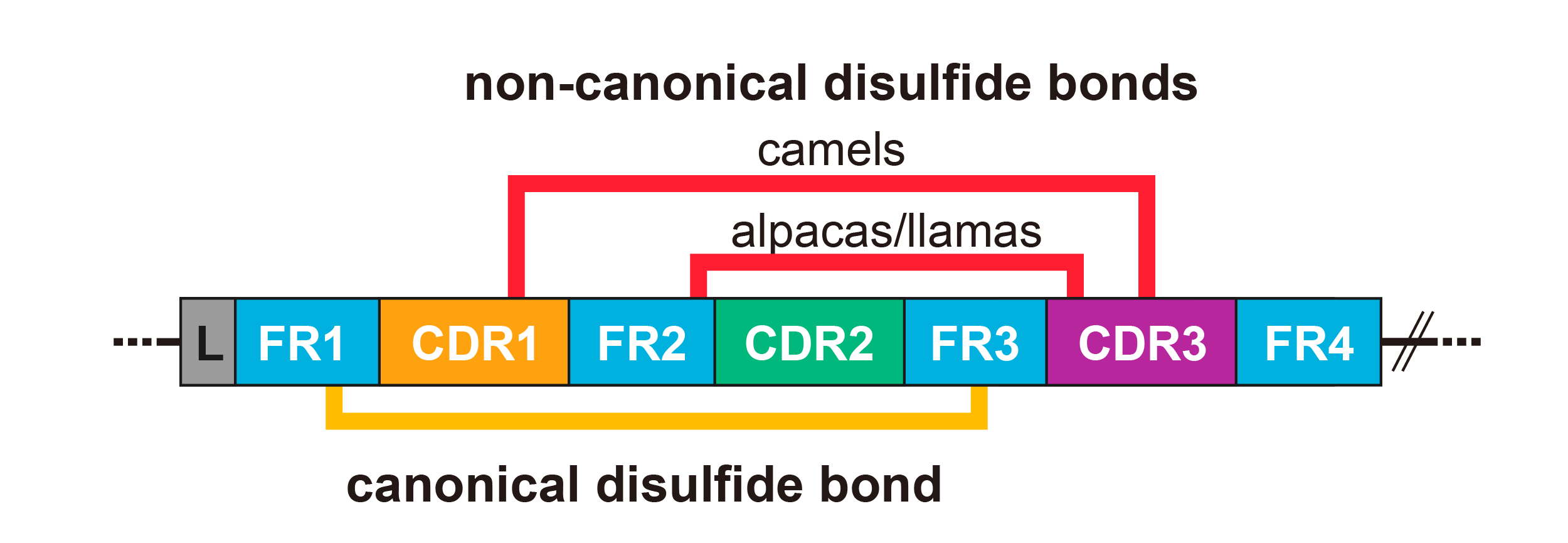
Figure 1.1: Genetic and Structural Differences in Non-Canonical Disulfide Bonds. Beyond the canonical disulfide bond (dark yellow) conserved across all antibody variable domains, Camelid VHHs frequently feature a non-canonical disulfide bond bridging CDR1 and CDR3. In contrast, New World Camelids (Alpacas) show a lower frequency, typically bridging FR2 and CDR3.

Figure 1.2: Topological Comparison of Non-Canonical Disulfide Bonded VHHs. (a) Alpaca VHH vs. (b) Camel VHH. The unique CDR1-CDR3 linkage found in Old World Camels acts as a structural anchor, forcing the CDR3 loop to extend outward, forming a distinct "Finger or Probe-like Configuration."
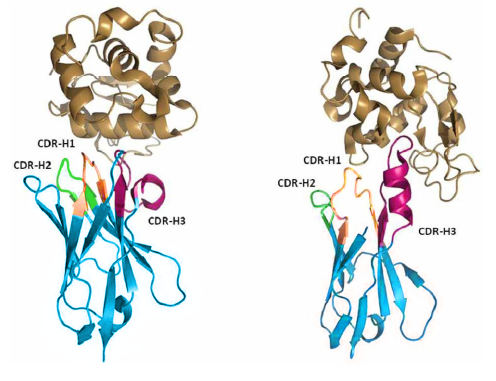
Figure 1.3: Epitope Accessibility. (a) The flatter binding surface of Llama/Alpaca VHHs is suitable for matching epitopes on the antigen surface. However, (b) to contact Cryptic Epitopes buried within antigenic clefts, one must screen for Camelid VHHs that possess both extension and rigidity.
The Screening Advantage:
- For General Antigens: The Camel library retains a significant proportion (approx. 15-20%) of standard, flat-configuration antibodies. Given our screening throughput of 10⁹ (billion-scale diversity), this translates to hundreds of millions of standard candidates. Thus, for conventional targets, we harvest high-affinity antibodies just as efficiently as Llama platforms.
- For Cryptic Epitopes: This is the decisive edge. When the target is an enzyme active site or a deep viral pocket, Llama antibodies are often blocked at the surface. In these scenarios, only the Camel VHH—with its "Finger-like CDR3" supported by the non-canonical disulfide bond—can penetrate and bind. Choosing the Camel platform ensures a solid foundation for routine tasks while equipping you with a specialized weapon to conquer "Undruggable Targets."
|
Q3: Is Humanization and Developability more difficult for Camel VHHs? |
This is an outdated concern. First, with the industry-wide adoption of Universal Humanized Scaffolds, the technology to graft Camel VHHs onto frameworks with high human homology is now mature and routine.
Second, in the hierarchy of drug development, Developability outweighs simple sequence similarity.
- Immunogenicity: This is not determined solely by how "human" the sequence appears, but by the molecule's stability and behavior in vivo.
- Key Metrics: We prioritize Thermostability (Tm), Solubility, and pI value (matching the antigen microenvironment). The non-canonical disulfide bond in Camel VHHs confers exceptional structural rigidity and resilience, which is, in fact, a significant advantage for a therapeutic modality.
|
Q4: How does your screening service help clients overcome development challenges? |
We understand that finding a high-affinity antibody is only half the journey. Our focus extends far beyond the humanization stage (which accounts for less than 20% of the engineering challenge). The real hurdle lies downstream in CMC (Chemistry, Manufacturing, and Controls) and Scale-up.
This is particularly true for "Finger-type" VHHs with hydrophobic CDR3s. If mishandled, these can be prone to aggregation during high-concentration production. Therefore, we provide a Turnkey Solution:
- Early Intervention: We introduce physicochemical property assessments within the screening rounds, rigorously eliminating clones prone to aggregation before they enter your pipeline.
- Meticulous Selection: Even with an abundant library, we insist on finding the "one in ten thousand." We only deliver candidates that achieve a perfect balance of affinity, yield, and stability.
|
Conclusion: Unlocking Research Potential with Artisan Spirit |
We choose the Old World Camel VHH platform not because it is the easiest path, but because it is the most powerful one.
Its unique evolutionary structure grants us the singular opportunity to unlock cryptic epitopes and solve intractable biological problems. While this demands a higher level of process engineering, that is precisely where our value lies.
We are not just an antibody screening vendor; we are your technical partner on the path to drug discovery. With deep craftsmanship and a passion for service, we promise to transform the "challenging" potential of the Camel VHH into the most stable, efficient clinical drug candidate in your hands. Let us turn scientific impossibility into therapeutic possibility.
