

Leadgene Leadgene
Human PD-L1, His Tag, HEK293
More Images
Catalog Number

LDG018PHM

More Documents
Loading package & price...
  • Overview

    Description

    PD-L1 regulates immune responses by binding to the immunoinhibitory receptor PD-1 on activated T-cells and B-cells. This interaction can suppress T-cell responses by inducing apoptosis and arresting cell-cycle progression. In cancer, PD-L1's role in reducing antigen-specific T cells can promote tumor growth and immune evasion. As a result, PD-L1 is considered as a potential therapeutic target for autoimmune diseases and cancer.
  • Specifications
    • Species of Origin

      Human

      Expression system

      HEK293

    • Affinity Tag

      His Tag (C-term)

      Buffer

      Lyophilized from a 0.2 µm filtered solution of PBS, pH 7.4.

    • Purity

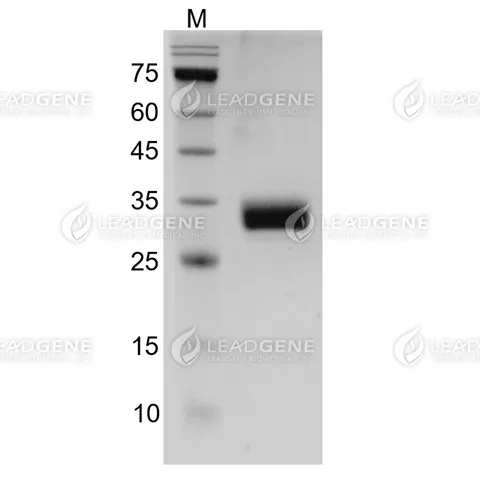
      >95% as determined by SDS-PAGE analysis.

      Molecular weight

      The protein has a calculated MW of 26 kDa.
      The protein migrates as 30-35 kDa uder reducing condition (SDS-PAGE analysis).

    • Activity

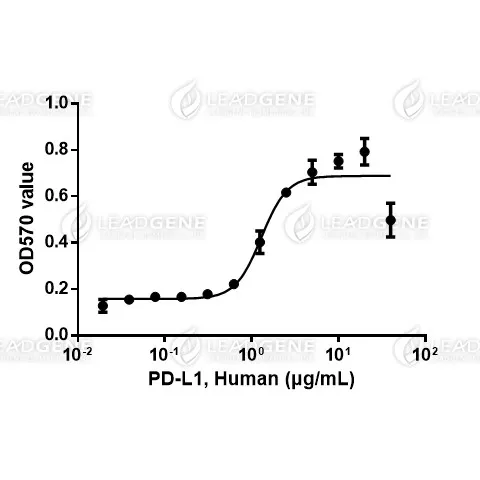
      Measure by its ability to induce adhesion in T-cell enriched PBMC cultures using a concentration range of 1-2 μg/mL.

      Endotoxin level

      <0.1 EU per 1 μg of the protein by the LAL method.

    • Form

      Lyophilized

  • Background
    • Background

      Programmed death-ligand 1 (PD-L1) is an immune checkpoint protein expressed on various cell types, including tumor cells. It interacts with PD-1 on T cells to suppress immune responses, enabling tumor immune evasion. Recombinant PD-L1 with a His tag, expressed in HEK293 cells, is crucial for studying PD-1/PD-L1 interactions, developing immune checkpoint inhibitors, and conducting functional assays in cancer immunotherapy research. The use of HEK293 cells ensures proper folding and post-translational modifications, maintaining biological activity.

      Synonyms

      CD274, B7-H1

    • Uniprot ID

      Q9NZQ7.1

      Sequence Note

      Phe19-Arg238

  • Instruction
    • Reconstitution

      It is recommended to reconstitute the lyophilized protein in sterile H₂O to a concentration of 200 μg/mL and incubate the stock solution for at least 20 min to ensure sufficient re-dissolved.

      Shipping

      The product is shipped with polar packs. Upon receipt, store it immediately at -20°C or lower for long term storage.

    • Stability & Storage

      This product is stable after storage at:

      • -20°C for 12 months in lyophilized state from date of receipt.
      • -20°C or -80°C for 1 month under sterile conditions after reconstitution.

      Avoid repeated freeze/thaw cycles.

  • Image
    SDS-PAGE analysis of recombinant human PD-L1.

    SDS-PAGE analysis of recombinant human PD-L1.

    Measure by its ability to induce adhesion in T-cell enriched PBMC cultures using a concentration range of 1-2 μg/mL. The ED₅₀ for this effect is 1.3 μg/mL.

    Measure by its ability to induce adhesion in T-cell enriched PBMC cultures using a concentration range of 1-2 μg/mL.
    The ED₅₀ for this effect is 1.3 μg/mL.

    1
    /
    2
    Total   (2)
  • Review

    Help others learn more about this product. Use the link below to share your experience.

  • Publication

    There are currently no publications. Use the link below to let us know.

  • Datasheet & Documents
    MSDS
    Manual
    1
    /
    1

Disclaimer:For Research Use or Further Manufacturing Only.

最後更新:

This site uses cookies as described in our Privacy Policy in order to improve your user experience and deliver customized advertising to you. Click “I Agree” to consent and continue.