





-
Species of Origin
Human
Expression system
CHO
-
Affinity Tag
His Tag (C-term)
Buffer
Lyophilized from a 0.2 µm filtered solution of PBS, pH 7.4.
-
Purity
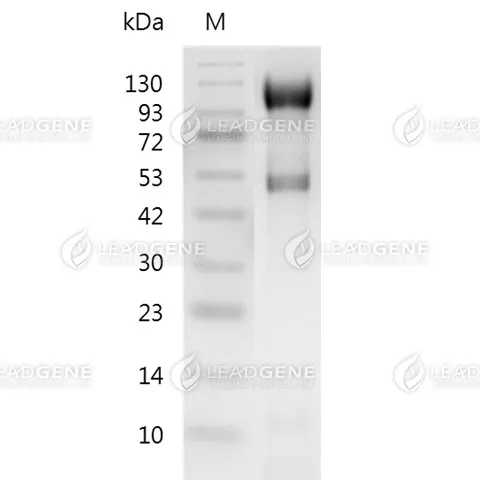
>95% as determined by SDS-PAGE analysis.
Molecular weight
The protein has a calculated MW of 85.81 kDa.
The protein migrates as 93-140 kDa under reducing condition (SDS-PAGE analysis). -
Activity
Measured by the ability of the immobilized protein to support the adhesion of U937 human histiocytic lymphoma cells. The ED50 for this effect is <2 μg/mL.
Form
Lyophilized
-
Specifications
-
Background
-
Background
Human P-selectin is a cell adhesion molecule expressed on the surface of activated endothelial cells and platelets. It plays a critical role in the early stages of inflammation by mediating the interaction between leukocytes and the vascular endothelium, leading to leukocyte rolling and recruitment to sites of tissue injury or infection. The Human P-selectin protein, when expressed in CHO (Chinese Hamster Ovary) cells, can be tagged with a His (histidine) tag, which aids in its purification and detection for research purposes. This recombinant P-selectin-His fusion protein is widely used in studies focused on inflammation, thrombosis, and vascular biology, as well as in the development of anti-inflammatory therapies.
Synonyms
P-selectin, CD62 antigen-like family member P, Granule membrane protein 140, GMP-140, Leukocyte-endothelial cell adhesion molecule 3, LECAM3, Platelet activation dependent granule-external membrane protein, PADGEM, CD62P
-
Uniprot ID
P16109
Sequence Note
Trp42-Ala771
-
-
Instruction
-
Reconstitution
It is recommended to reconstitute the lyophilized protein in sterile H₂O to a concentration of 200 μg/mL and incubate the stock solution for at least 20 min to ensure sufficient re-dissolved.
Shipping
The product is shipped with polar packs. Upon receipt, store it immediately at -20°C or lower for long term storage.
-
Stability & Storage
This product is stable after storage at:
- -20°C for 12 months in lyophilized state from date of receipt.
- -20°C or -80°C for 1 month under sterile conditions after reconstitution.
Avoid repeated freeze/thaw cycles.
-
-
Image
![Activity analysis of recombinant Human P-selectin, His Tag, CHO. Measured by the ability of the immobilized protein to support the adhesion of U937 human histiocytic lymphoma cells. The ED50 for this effect is <2 μg/mL.]()
Activity analysis of recombinant Human P-selectin, His Tag, CHO.
Measured by the ability of the immobilized protein to support the adhesion of U937 human histiocytic lymphoma cells. The ED50 for this effect is <2 μg/mL.![SDS-PAGE analysis of recombinant Human P-selectin.]()
SDS-PAGE analysis of recombinant Human P-selectin.
1/2 -
Review

Help others learn more about this product. Use the link below to share your experience.
-
Publication

There are currently no publications. Use the link below to let us know.
-
Datasheet & Documents
1/1
Disclaimer:For Research Use or Further Manufacturing Only.
最後更新:

