




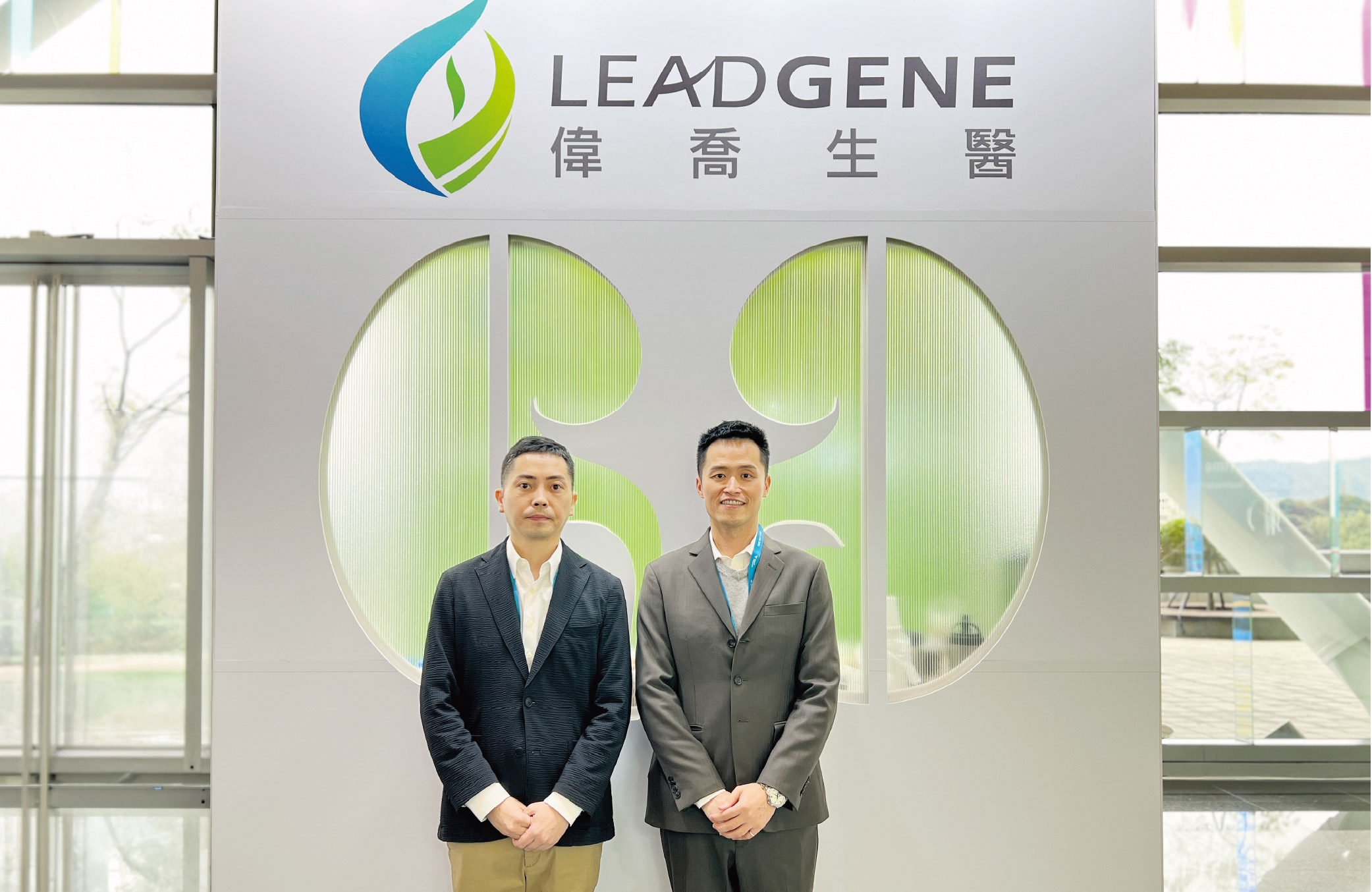
Dr. Yung-Chun Chuang, Chairman of Leadgene Biomedical (left), and Dr. Yu-Wei Cheng, CEO of Leadgene Biomedical (right)
Original article by Pei-An Wu (Transliteration).
Translated by Leadgene Biomedical, Inc.
Established in 2019, the National Biobank Consortium of Taiwan (NBCT) integrates resources from 38 biobanks across the country, with a total of 1.13 million registered cases. Amid global trends in precision medicine and biotech R&D, NBCT has become Taiwan’s largest biomedical data resource. Dr. Shiu-Feng Huang, Director of the NBCT platform, noted that as of the end of March this year, 244 applications from hospitals and industry had been approved. Among these, cancer-related projects are currently the most active.
In 2024, NBCT successfully integrated whole-genome analysis data and clinical data from 2,177 breast cancer cases with the full genomic dataset from Academia Sinica’s Taiwan Biobank. This integration enabled data applicants to participate in the international biobank consortium project “INTERVENE,” with research results already published.
In 2025, NBCT expanded its value-added applications to two diseases: approximately 1,000 prostate cancer cases and 2,600 stroke cases (including both hemorrhagic and ischemic stroke). Whole-genome analysis and detailed clinical data were successfully completed for these cohorts.
In 2026, NBCT selected two major cancers affecting the Taiwanese population—lung adenocarcinoma and colorectal cancer—for further value-added applications. The lung adenocarcinoma cohort includes approximately 3,000 cases with EGFR mutation data, while the colorectal cancer cohort includes around 2,000 cases, prioritizing patients under 50 years old. Whole-genome analysis and comprehensive clinical data will be established for both groups.
This year, NBCT will once again integrate its data with the 200,000 whole-genome datasets from Academia Sinica’s Taiwan Biobank. The combined dataset will be made available to researchers across Taiwan interested in genomic data analysis. NBCT is also openly inviting outstanding scholars interested in genomic big data research to apply for funding support, with the goal of advancing research on disease-related genetics in Taiwan.
Beyond cancer, NBCT also played a key role during the COVID-19 pandemic. Dr. Huang explained that many domestic testing companies urgently needed compliant clinical samples for product development. In response, NBCT established a COVID biobank, attracting applications from multiple companies.
Although early efforts to collect respiratory samples were limited due to biosafety regulations—affecting some virus detection product development—blood samples were successfully used to support applications such as antibody testing. Dr. Huang highlighted that some companies were able to quickly apply through the platform during the early stages of the pandemic and later obtained Emergency Use Authorization (EUA) both domestically and internationally, using Taiwan as a key starting point for product development.
She also noted that once companies become familiar with the platform, they tend to return for additional applications, indicating strong usability and user retention.
User Experience: AllBio Science, Inc. and Leadgene Biomedical
In this interview, Dr. Chang-Wei Li, CEO of AllBio Science, Inc., and Dr. Yu-Wei Cheng, CEO of Leadgene Biomedical, Inc., shared their experiences working with NBCT to develop diagnostic products and services.
Dr. Li explained that his first encounter with NBCT dates back to the COVID-19 pandemic. Although AllBio Science had already obtained IRB approvals from multiple hospitals in Taiwan, they still faced challenges in securing sufficient sample sizes for execution. This led them to seek more efficient sample sourcing channels. He later learned about NBCT during a Taiwan Biobank seminar hosted by Academia Sinica and began submitting applications.
During the development of breast cancer testing and related LDT (laboratory-developed test) applications, AllBio Science used the NBCT platform to match with hospitals across Taiwan and obtain blood samples with specific genetic variants, such as BRCA mutations. Both positive and negative samples were successfully acquired.
Dr. Li noted that although the process was initially unfamiliar, it became smoother with experience. He suggested that first-time applicants communicate with NBCT coordinators in advance and confirm whether clinical trial qualifications are required, which can improve application efficiency.
He also pointed out that while most samples obtained through NBCT are currently used for cancer diagnostics development, the platform is particularly valuable for accessing rare samples—such as emerging viruses, uncommon mutations, or less frequently collected specimen types—that are difficult to obtain through traditional channels.
He further expressed hope that NBCT will enhance transparency and digitalization in the future, such as clearly listing available sample types and categories on its official website to help industry users quickly assess suitability.
Dr. Yu-Wei Cheng, CEO of Leadgene Biomedical, shared that during the development of Leadgene Biomedical’s indoxyl sulfate (IS) ELISA Kit, the company sought to ensure consistent performance across diverse patient backgrounds. After completing initial development and performance evaluation, Leadgene utilized the NBCT platform to include 249 samples for further validation, including both low and high IS concentration samples for stress testing.
The results demonstrated that even under more diverse and challenging sample conditions, the assay maintained excellent data stability, successfully validating its high sensitivity and specificity. Dr. Cheng noted that the product is currently in the final review stage for establishing a reference range for healthy individuals.
“NBCT’s diverse resources provide a setting that simulates real-world clinical challenges, enabling products to develop strong real-world performance and generate more representative baseline data. This is critical for helping healthcare professionals identify potential risks early and gives us confidence that the product can provide accurate clinical references even in complex cases,” said Dr. Cheng.
Dr. Cheng emphasized that NBCT is a critical infrastructure for Taiwan’s biotech industry in advancing toward precision medicine and internationalization. It not only strengthens the data capabilities of Taiwanese biotech products but also enhances the global credibility of Taiwan’s R&D outcomes.
“It consolidates Taiwan’s valuable medical resources, allowing even small and medium-sized biotech companies to compete globally using big data. Beyond companies like ours focused on in vitro diagnostics (IVD) and precision testing, sectors such as new drug development and efficacy evaluation, preventive medicine and precision screening, and AI-driven healthcare applications can all benefit from this platform,” Dr. Cheng added.
Zuletzt aktualisiert:
