Leadgene Leadgene
Lactate Oxidase (LOX)
Mehr Bilder
Katalognummer

LDG0036RG

Weitere Dokumente
Paket & Preis werden geladen...
  • Übersicht

    Beschreibung

    Lactate oxidase (LOX) is an enzyme that catalyzes the oxidation of L-lactate to pyruvate and hydrogen peroxide. This flavoprotein, primarily found in bacteria and fungi, plays a crucial role in various biological processes, including energy metabolism and redox regulation. Due to its high specificity for lactate, LOX is widely utilized in biosensors for detecting lactate in clinical diagnostics, food quality control, and sports science. Its application allows for accurate and rapid quantification of lactate levels.
  • Spezifikationen
    • Expressionssystem

      Escherichia coli

      Detektionsmethode

      Spectrophotometry

    • Konzentration

      200 U/mg or more

      Aktivität

      Activity can be calculated by the following formula :
      Volume activity (U/mL) = ΔOD (OD test−OD blank)×Vt×df/ (34.3×1/2×t×1.0×Vs) = ΔOD×0.237×df
      Weight activity (U/mg) = (U/mL)×(1/C)
      Vt: Total volume (1.525 mL)
      Vs: Sample volume (0.025 mL)
      34.3: Millimolar extinction coefficient of quinoneimine dye under the assay condition (cm²/micromole)
      1/2: Factor based on the fact that one mole of H₂O₂ produced half a mole of quinoneimine dye
      t: Reaction time (15 minutes)
      1.0: Light path length (cm)
      df: Dilution factor
      C: Enzyme concentration (C mg/mL)

    • Einheitsdefinition

      One unit causes the formation of one micromole of hydrogen peroxide (half a micromole of quinoneimine dye) per minute under the following conditions: 20 mM potassium phosphate buffer (pH 7.5), 48 mM D-L-lactate, 1.2 mM 4-aminoantipyrine, 0.76 mM EHSPT, and 2.4 U/mL peroxidase.

      Form

      Lyophilized

  • Hintergrund
    • Synonyme

      LOX, LctO, Lactic oxygenase, Lactic oxidase, Lactate monooxygenase, L-lactate oxidase

  • Anleitung
    • Rekonstitution

      It is recommended to weight and reconstitute 10 mg of lyophilized powder in 200 μL double-distilled water directly and incubate the solution for at least 10 mins to ensure sufficient re-dissolved.

      Versand

      The product is shipped with polar packs. Upon receipt, store it immediately at -20°C or lower for long term storage.

    • Stabilität & Lagerung

      This product is stable at -20°C for long-term storage under sterile conditions.
      Avoid repeated free-thaw cycles.

  • Bild
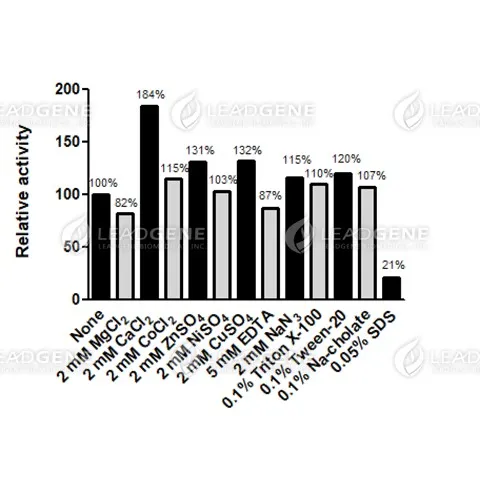
    The effects of various chemicals on LOX. The enzyme was incubated with the chemicals at 25°C for 1 hour.

    The effects of various chemicals on LOX.
    The enzyme was incubated with the chemicals at 25°C for 1 hour.

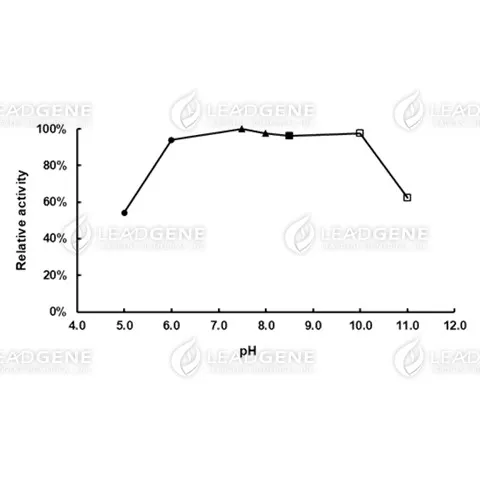
    pH stability of LOX. The enzyme powder was reconstituted by double-distilled water and treated with different pH buffer condition at 25°C for 16 hours. pH 4.0-6.0, 0.1 M Sodium citrate buffer; pH 7.5-8.0, 0.1 M Potassium phosphate buffer; pH 8.5, 0.1 M Tris-HCl buffer; pH 10.0-11.0, 0.1 M Carbonate-bicarbonate buffer.

    pH stability of LOX.
    The enzyme powder was reconstituted by double-distilled water and treated with different pH buffer condition at 25°C for 16 hours. pH 4.0-6.0, 0.1 M Sodium citrate buffer; pH 7.5-8.0, 0.1 M Potassium phosphate buffer; pH 8.5, 0.1 M Tris-HCl buffer; pH 10.0-11.0, 0.1 M Carbonate-bicarbonate buffer.

    Thermal stability of LOX. The enzyme powder was reconstituted by double-distilled water and treated at different temperatures for 10 minutes. Final concentration: 10 U/mL.

    Thermal stability of LOX.
    The enzyme powder was reconstituted by double-distilled water and treated at different temperatures for 10 minutes. Final concentration: 10 U/mL.

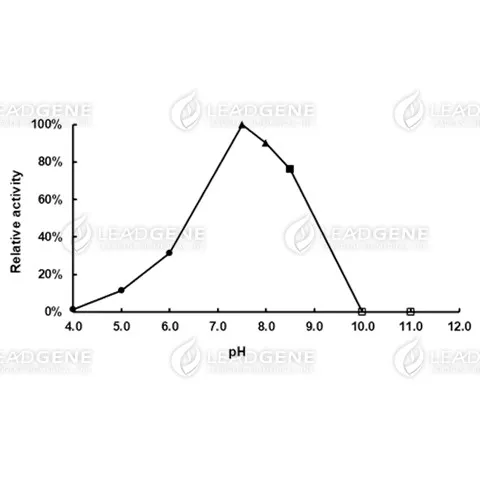
    pH activity of LOX. The buffer conditions with various pH values were used in the reaction at 37°C. pH 4.0-6.0, 0.1 M Sodium citrate buffer; pH 7.5-8.0, 0.1 M Potassium phosphate buffer; pH 8.5, 0.1 M Tris-HCl buffer; pH 10.0-11.0, 0.1 M Carbonate-bicarbonate buffer.

    pH activity of LOX.
    The buffer conditions with various pH values were used in the reaction at 37°C. pH 4.0-6.0, 0.1 M Sodium citrate buffer; pH 7.5-8.0, 0.1 M Potassium phosphate buffer; pH 8.5, 0.1 M Tris-HCl buffer; pH 10.0-11.0, 0.1 M Carbonate-bicarbonate buffer.

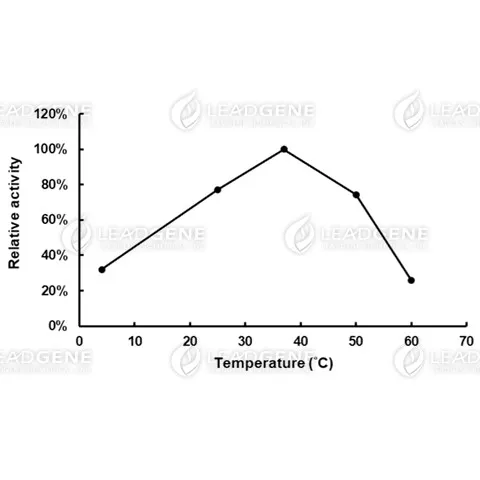
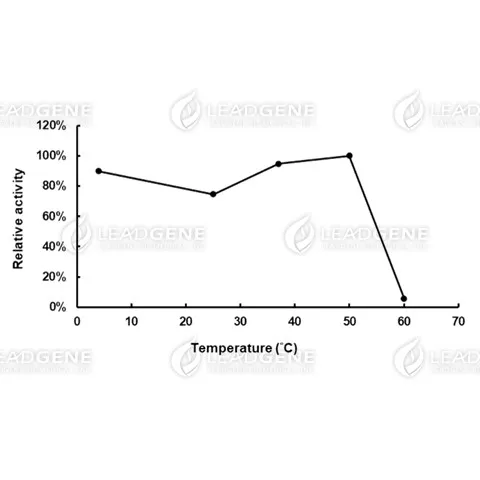
    Temperature activity of LOX. The enzyme reactions in 20 M K-Phosphate buffer, pH 7.5, were carried out under different temperatures.

    Temperature activity of LOX.
    The enzyme reactions in 20 M K-Phosphate buffer, pH 7.5, were carried out under different temperatures.

    1
    /
    5
    Gesamt   (5)
  • Bewertung

    Helfen Sie anderen, mehr über dieses Produkt zu erfahren. Nutzen Sie den Link unten, um Ihre Erfahrung zu teilen.

  • Publikation

    Derzeit gibt es keine Publikationen. Nutzen Sie den Link unten, um uns zu informieren.

  • Datenblatt & Dokumente
    Datenblatt
    MSDS
    1
    /
    1

Haftungsausschluss:For Research Use or Further Manufacturing Only.

Diese Website verwendet Cookies wie in unserer Privacy Policy beschrieben, um Ihre Nutzererfahrung zu verbessern und Ihnen maßgeschneiderte Werbung anzubieten. Klicken Sie auf „Ich stimme zu", um zuzustimmen und fortzufahren.