Leadgene Leadgene
Glucose Dehydrogenase (GLD) (NAD(P)-Dependent)
Mehr Bilder
Katalognummer

LDG0023RG

Weitere Dokumente
Paket & Preis werden geladen...
  • Übersicht

    Beschreibung

    Glucose dehydrogenase (GLD) (NAD(P)-dependent) is an enzyme that catalyzes the oxidation of glucose to gluconolactone while reducing the coenzymes NAD+ or NADP+ to NADH or NADPH. This enzyme is widely used in biosensors and diagnostic assays to measure blood glucose levels. Its high specificity and stability make it an essential tool in various biomedical applications.
  • Spezifikationen
    • Expressionssystem

      Escherichia coli

      Aktivität

      ≥ 300 U/mg

    • Einheitsdefinition

      One unit causes the formation of one micromole of NADH per minute under the conditions described below.
      (85.25 mM Tris-HCl,147.54 mM D-Glucose, 3.66 mM NAD+)

      Form

      Lyophilized (White amorphous powder)

  • Anleitung
    • Rekonstitution

      It is recommended to reconstitute the lyophilized powder in 1 mL double-distilled water directly (final activity is 20 U/ μL) and incubate the solution for at least 10 mins to ensure sufficient re-dissolved.

      Versand

      The product is shipped with polar packs. Upon receipt, store it immediately at -20°C or lower for long term storage.

    • Stabilität & Lagerung

      This product is stable at -20°C for long-term storage under sterile conditions.
      Avoid repeated free-thaw cycles.

  • Bild
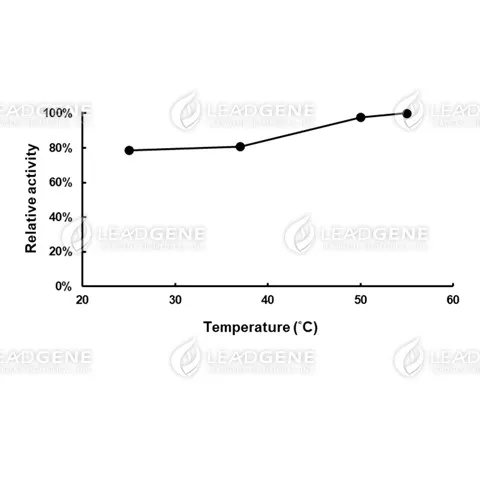
    Temperature activity of Glucose dehydrogenase. The enzyme reactions in 0.1 M Tris-HCl buffer, pH 8.0, were carried out under different temperature.

    Temperature activity of Glucose dehydrogenase. The enzyme reactions in 0.1 M Tris-HCl buffer, pH 8.0, were carried out under different temperature.

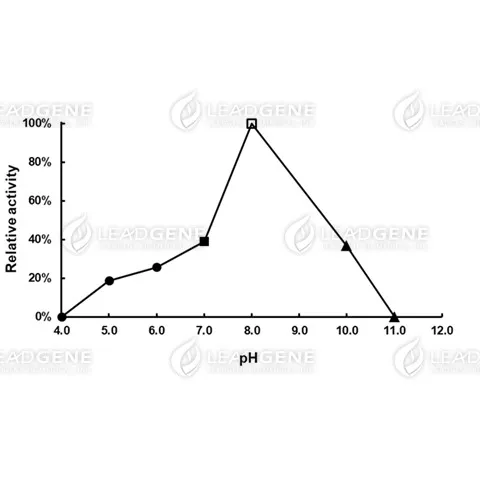
    pH activity of Glucose dehydrogenase. The buffer conditions with various pH values were used in the reaction at 37°C. pH 4.0-6.0, 0.1 M Sodium citrate buffer; pH 7.0, 0.1 M Potassium phosphate buffer; pH 8.0, 0.1 M Tris-HCl buffer; pH 10.0-11.0, 0.1 M Carbonate-bicarbonate buffer.

    pH activity of Glucose dehydrogenase. The buffer conditions with various pH values were used in the reaction at 37°C. pH 4.0-6.0, 0.1 M Sodium citrate buffer; pH 7.0, 0.1 M Potassium phosphate buffer; pH 8.0, 0.1 M Tris-HCl buffer; pH 10.0-11.0, 0.1 M Carbonate-bicarbonate buffer.

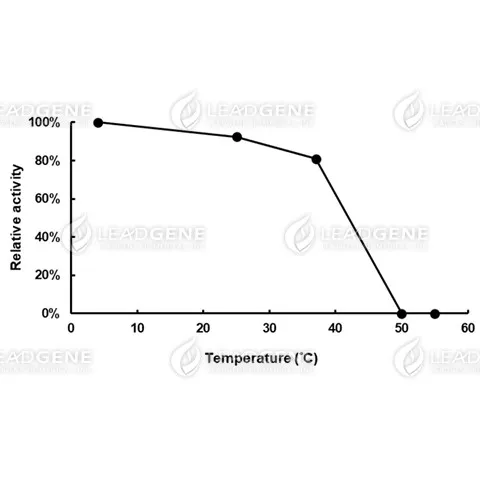
    Thermal stability of Glucose dehydrogenase. The enzyme powder was reconstituted by double-distilled water and treated with different temperature for 15 minutes. Final concentration: 23.5 U/ mL

    Thermal stability of Glucose dehydrogenase. The enzyme powder was reconstituted by double-distilled water and treated with different temperature for 15 minutes. Final concentration: 23.5 U/ mL

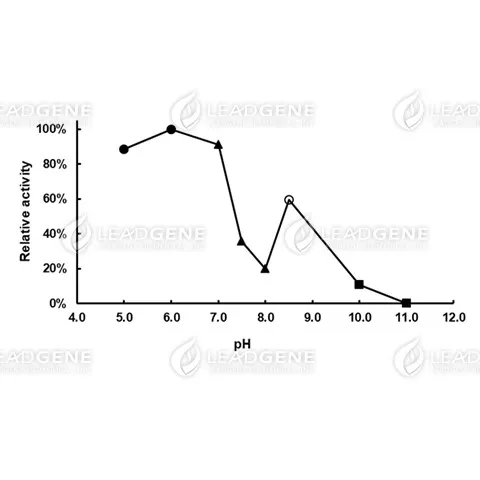
    pH stability of Glucose dehydrogenase. The enzyme powder was reconstituted by double-distilled water and treated with different pH buffer condition for 20 hours. pH 4.0-6.0, 0.1 M Sodium citrate buffer; pH 7.0-8.0, 0.1 M Potassium phosphate buffer; pH 8.5, 0.1 M Tris-HCl buffer; pH 10.0-11.0, 0.1 M Carbonate-bicarbonate buffer.

    pH stability of Glucose dehydrogenase. The enzyme powder was reconstituted by double-distilled water and treated with different pH buffer condition for 20 hours. pH 4.0-6.0, 0.1 M Sodium citrate buffer; pH 7.0-8.0, 0.1 M Potassium phosphate buffer; pH 8.5, 0.1 M Tris-HCl buffer; pH 10.0-11.0, 0.1 M Carbonate-bicarbonate buffer.

    1
    /
    4
    Gesamt   (4)
  • Bewertung

    Helfen Sie anderen, mehr über dieses Produkt zu erfahren. Nutzen Sie den Link unten, um Ihre Erfahrung zu teilen.

  • Publikation

    Derzeit gibt es keine Publikationen. Nutzen Sie den Link unten, um uns zu informieren.

  • Datenblatt & Dokumente

Haftungsausschluss:For Research Use or Further Manufacturing Only.

Diese Website verwendet Cookies wie in unserer Privacy Policy beschrieben, um Ihre Nutzererfahrung zu verbessern und Ihnen maßgeschneiderte Werbung anzubieten. Klicken Sie auf „Ich stimme zu", um zuzustimmen und fortzufahren.